Home -
Austria -
Benelux -
Channel Islands -
Germany -
Italy -
Poland -
Russia -
Spain -
Sweden -
Switzerland -
Turkey -
United Kingdom -
United States
Back to reviews in France & Monaco
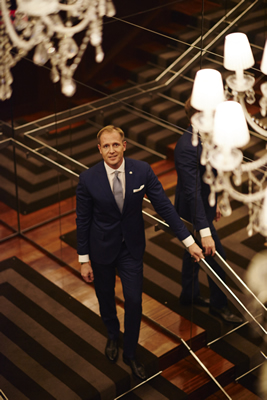 The maiden aunt of Parisian grand hotels has been transformed into the exciting young niece. Of all the palace hotels in Paris, one always used to strike me as being quieter and more reserved than the rest. No longer. The staid old Royal Monceau has become the flamboyant Raffles Royal Monceau. For the designer Philippe Starck has waved his magic wand, and the most traditional hostelry in Paris has become an Aladdin’s Cave of modern art and design. There is a private cinema, an ‘art concierge’ (to help you buy your next Picasso), an art bookshop and a gallery for contemporary art called, ‘Art District’. Then, after such aesthetic excitement, you can relax at the Clarins Spa and have a dip in its 23 metre pool. And over all this presides one of Europe’s best hotel managers, the charming Aaron Kaupp (pictured).
The Royal Monceau has been an adornment to the avenue Hoche since 1928. The Allied general staffs had the good sense to stay here in 1945, and three years later it was here that David Ben Gurion signed the proclamation creating the state of Israel. My own presence was perhaps of less historical significance, but I am sure that I appreciated my surroundings just as much as my distinguished predecessors. Mr Starck cares about details and he has a sense of humour. There was therefore much to occupy the eye in my suite on the fifth floor.
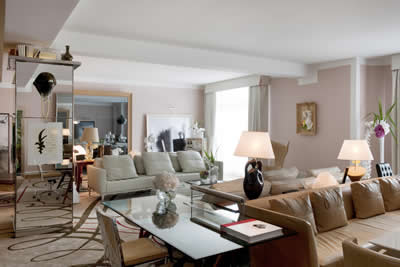
Room 518 is a ‘Gallery Suite’ (1,608€ a night, breakfast extra). I entered and spotted immediately the guitar in the sitting room. Sadly, my musical instruction never progressed further than that required for the lowest examination grade of the violin, so I felt I should leave the instrument un-plucked. Instead, I admired the numerous mirrors, the abundance of light wood, the handsome leather sofa and the large writing desk. The top of the last appeared skew-whiff, so I attempted (and failed) to straighten it – but, of course, I had failed to realise its ‘skew-whiffness’ was one of the designer’s little jokes.
 Sliding doors led into my bedroom, with its wonderfully soft and comfortable bed and its dressing-room off. Then further sliding doors opened into my bathroom. I like large bathrooms, and this chamber of white marble was large. Its two wash basins were square and rather shallow, but its bath tub was very much to my taste: curvaceous and deep. The separate shower room was useful, as was the separate lavatory. In the latter I found something which gave me a fright. This was my first encounter with a loo seat which, apart from being heated, lifted itself. Thus does technology march on.
Breakfast (58€) is served in the restaurant La Cuisine on the ground floor. Here I spent my mornings – for I do not rush the first meal of the day – at a table in an alcove, sitting upon a dark grey sofa. On no account should you miss breakfast at the Royal Monceau, for in every respect it is excellent. And here I should mention the kind and attentive service I experienced throughout the hotel, from members of staff who were unfailingly efficient and courteous and who used my name in a proper and friendly manner. The breakfast buffet is stocked with fine comestibles, including breads, jams, honey, cheeses, fruit and smoked salmon. And the waitresses were happy to bring to me mushrooms on toast, bacon, superb scrambled egg and my Grandfather’s Breakfast (porridge made with water, brown bread and butter and sliced, raw onion). These beginnings to my days were hugely enjoyable.
 In the evenings La Cuisine becomes Matsuhisha Paris, a highly regarded Japanese restaurant with Hideki Endo as the Executive Chef. But I dined at the Royal Monceau’s Michelin-starred Italian restaurant, Il Carpaccio, which occupies an intimate conservatory overlooking the hotel’s inner garden. With its discreet lighting, white napery, leather armchairs and waiters in dark suits, this is a space which suggests seriously good cuisine. And seriously good cuisine is exactly what I got.
It being the season of the Divine Fungus, I decided to have the Black Truffle Menu (263€). This displayed Chef Michele Fortunato’s admirable talent for taking the finest ingredients, handling them with intelligence and flair, and sending from his kitchen dishes which are as ravishing to the eye as they are delightful to the palate. First came carpaccio of sea bream, delicate and delicious, with the truffle shaved over the top at the table. Next it was tremendously good tagliolini. Before it was presented to me it was rolled around within a huge Parmigiano cheese (which had been sliced in two horizontally). Then, when it was set before me, a multitude of flakes of truffle gently descended upon its welcoming form. This was as good a version of this classic dish as I have ever eaten – and I have eaten quite a few. My main course was a handsome piece of beef fillet, with lovely mashed potatoes and truffle. And I finished with an iced hazelnut parfait, which reminded me of the choc ices to which I was devoted in my childhood.
The Italian waiters, orchestrated by Maitre d’ Mauro Mannai, provided service which was pleasant and courteous. There was canned music – of which I am not a fan – but it was low and inoffensive. Chef Sommelier Marcantonio Sassi presides over a wine list which, apart from the champagnes, is all Italian. The prices of its 382 offerings run from 45€ for a Puglian white to 10,000€ for a jeroboam of 1999 Cristal champagne. Other bottles to catch my eye were: Krug Grande Cuvée (390€), 2013 Cervaro della Sala (185€), 2010 Solaia (850€), 2011 Tignanello (550€), 2011 Sassicaia (950€) and 2013 Masseto (1,800€). Champagnes by the glass include one of my favourites, the toasty Laurent Perrier Grande Siècle (39€).
I left Il Carpaccio full of gastronomic joy and full, too, of admiration for the whole hotel, which has been re-invented to great effect. The Raffles Royal Monceau is now one of the liveliest of the palace hotels of Paris.


37 avenue Hoche, Paris 75008, France.
Telephone +33 (0)1 42 99 88 00
Fax +33 (0)1 45 63 12 69
Email: paris@raffles.com
www.leroyalmonceau.com
Double rooms from 850€, breakfast extra